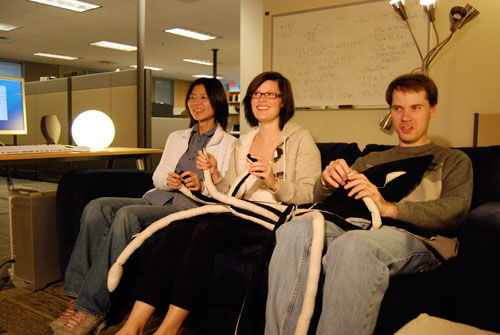
Another successful Adafruit collaboration! Ladyada and I made this EL wire (electro-luminescent wire) tutorial video (on CRAFT) and Tron bag. Her EL photo tutorial is the best one on the ‘net, and this video really shows the (delicate) process of getting the soldering just right. You can get EL wire from the Adafruit shop.
Limor “Ladyada” Fried and I just finished up an extensive tutorial on hacking the Brother KH-930e knitting machine. We show you how to make your own cable for interfacing with the machine, then how to use it to put custom patterns on the machine without entering them by hand, as I had been doing previously (one excruciating pixel at a time). I made the above tessellating adafruits fabric and the dithering experiment below.
Have questions? Don’t ask them here or send me email, ask in the adafruit forum.
I added these blinking lights to my fatlab patch for riding my bike at night. Here I’ll show you how to add flashing LEDs to your backpack for fun and safety. I used a LilyPad Arduino with a rechargeable lithium-polymer battery for flatness and re-usability. The LEDs blink in a marquee pattern, two at a time, in patriotic red, white and blue.
Materials and Tools: -scissors -needlenose pliers -sewing needle -LilyPad Arduino with programmer and USB cable – Maker Shed
Power: -LiPower board – Sparkfun -lithium-polymer battery (and charger) – Sparkfun OR -LilyPad AAA battery holder (comes with the Maker Shed kit linked above)
-conductive thread – Lame Lifesaver -conductive velcro – Less EMF -sticky-back velcro (I got mine at Michael’s) -bag or backpack -fabric patch to mount circuit -small scrap of fabric for switch -thread –source code and schematic
I made a robotic toy scorpion in 2008. Here’s a video about it! Originally posted on MAKE.
I made this scorpion toy with a Twitchie Robot Kit. I’m really afraid of scorpions where I live in Arizona, so I thought a friendly toy would help me get used to them. I made his plush body from some fabric I had around, aiming to make him look like an Arizona bark scorpion, which are tan/yellowish/translucent.
Whenever I bring my TV-B-Gone out to restaurants, I always look real suspicious holding it up and pointing it around, so I’ve been looking for a more subtle and dinner-appropriate solution. I got zippered hoodie sweatshirt from the thrift store which had a convenient logo on the upper left front, complete with rhinestones! I thought the IR LEDs would blend in quite nicely, so I stitched it into the sweatshirt. The batteries are in the pocket. I broke out the pushbutton leads and used conductive thread to sew paths to the edge of the zipper, which has a metal pull. I made two little pads with the thread that are bridged by the zipper pull when it passes by, so all I have to do is zip the sweatshirt up or down to activate the TV turning-off action. Works great! I made an instructable for this project so you can see how to make your own. You can also view the full set on Flickr.
You can buy my LED sewing kit (whose parts can be used to make one).
I’ve been working with Leah Buechley’s LilyPad Arduino, and in true embroidery sampler fashion, have composed this circuit to see what I could do. The embroidery uses traditional floss and techniques mixed with lights and sounds generated by the onboard software. The amount of light sensed by the sensor changes the speed and pitch of the lights and sounds generated. Move your shadow or hand over it to experience the changes.
Sensor Squid Relation Game, by Rebecca Stern and Lisa Tolentino in the Arts, Media and Engineering Program at ASU, 2008
The Reflective Living Group in AME is currently developing a tangible mediated environment designed to facilitate the growth of group creativity between colleagues in a transdisciplinary research workplace. Our initial work in developing playful mediated work environments contributes to a framework for constructing “creativity interventions,” some of the goals of which are to (1) stimulate constructive discourse, (2) strengthen social bonds, and (3) enhance creative output in diverse communities of IT practitioners. Through our multi-user tangible interface in the form of a plush sensor-enabled squid, participants can share media resources and collaborate in a playful and inviting setting.
sGlobject Trumpet & Tambourine (sGloTaT) by Ryan Brotman, Byron Lahey, and Rebecca Stern
The sGloTaT sonic environment allows participants to originate sound by moving physical objects. It encourages novice users to play by naturally gesturing with two tangible user interface objects emulating a trumpet and tambourine. In this sound space, movements by the users generate visual feedback projected on the floor in the form of a three-dimensional rendering of a cone.
This is the final project for Computational Principles for Media Arts, a fall 2007 class in Arts, Media and Engineering at Arizona State University. Please download the following paper for more information.
Sternlab’s Becky Stern has collaborated with artist Rees Shad on the Declarative Lamp Project, on display as part of the Kingston, NY Sculpture Biennial through October, 2007. (Lamps are on display in the uptown Kingston Peace Park)
Mr. Shad writes:
In January of 2007 the city of Boston was partially paralyzed by a bomb scare wherein a number of found electronic devices were seen as potential explosives. The devices featured a number of small flashing lights depicting a cartoon alien performing a crude gesture. Intended to advertise the upcoming season of a popular animated television show, this misadventure in guerilla marketing was perceived as a potential hazard to the population, or, even worse, a terrorist act. The Bomb Squad was called out to destroy the devices, and the city’s major traffic paths came to a standstill for most of an afternoon. My first thought upon hearing about the Boston scare was that our fears had gotten the best of us. My next thought was that I needed to address this in my work as an electronic installation artist.
The Declarative Lamp Project, created in collaboration with artist Rebecca Stern, uses electronic performance to explore the extent to which fear has been instilled in American culture. Witnesses in a park experience seemingly innocuous electronic pathway lighting that comes alive at dusk with lights and voices in many languages declaring, “I am not a bomb.”
Because these devices exist in a natural environment and use human voices, I wished to add natural and personal elements to the Lamps’ execution. As a child, I remember being fascinated by the mathematical equation to calculate air temperature from the frequency of cricket chirps. If one monitors a single chirping cricket for 15 seconds, the number of chirps plus 39 is the air temperature (in Fahrenheit). In our piece, this equation has been reversed to allow the evening’s temperature to establish the rhythm of the declarative voices. In cold temperatures, the lamps speak less often than in warm.
To give an innocuous overtone, we chose a number of Arts & Crafts style solar-powered garden lights as the framework within which to build our project. Ordinarily, these lamps store energy during daylight hours and engage an energy-efficient LED light at dusk. Ms. Stern and I have repurposed these lamps to flicker as if they hold lightning bugs in correlation with the recorded messages. This process begins at dusk, producing a chorus of voices whose rhythm is directly related to the temperature of the evening air. The lamps each repeat the phrase “I am not a bomb” in one of twelve languages. After a twenty-minute performance, the lamps power down to await the next sunset.