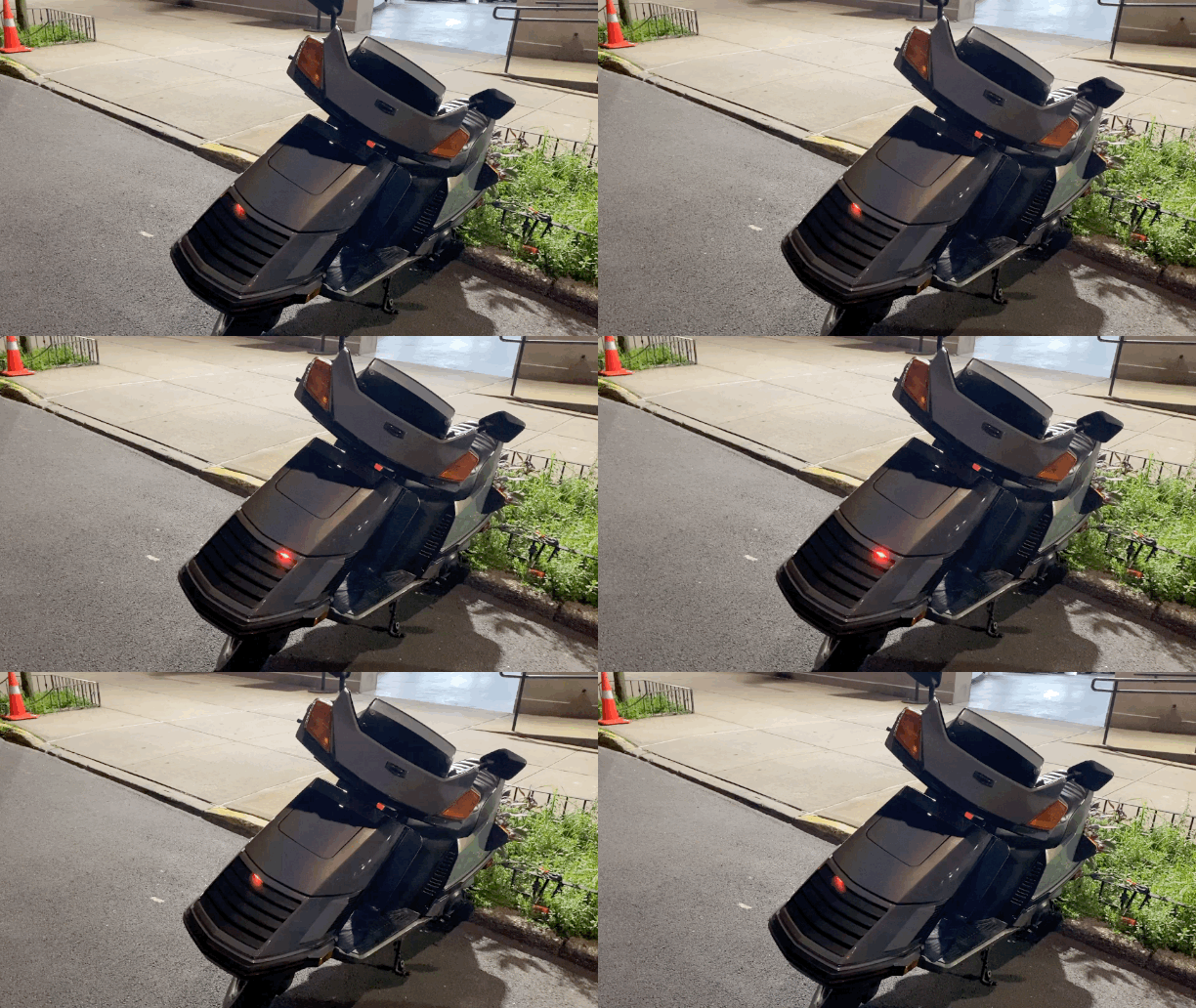
This project is a very 80s upgrade to a very 80s scooter– I’m putting an LED strip in the grill of my boyfriend Smokey’s Honda Elite to create a larson scanner animation effect while teaching him how to solder.
Supplies
For this project I used a strip of WS2812b LED strip, also known as NeoPixels. I chose the densest variety to pack as many LEDs in as possible for a nice smooth animation effect.
This project helps make your day a little easier if you’re a remote worker using Slack. I’ll show you how to build it using an ESP8266 wifi board. Don’t miss the video above for the overview.
Whether you’re new to using Slack or you’ve just been using it a lot more lately, you’ll understand the importance of setting your Slack status. It lets your colleagues know if you’re available to chat, in a meeting, out sick, etc.
Forget to set it when you leave your desk, and you may get interrupted by somebody who thinks you’re available. I thought it would help me remember to have a physical device on my desk that can set my Slack status for me. This project is a collaboration with Brian Lough, who’s an ESP whiz and author of many Arduino API libraries including this new one for Slack. You might remember my YouTube subscriber counter, which was also written using one of Brian’s API libraries.
This project is a pair of bedside shelves made from maple and epoxy resin. This wood has a bunch of beetle holes in it, some of which I filled with silver wire as an accent. Let’s get started.
I recently put a ham radio antenna on my roof, so I could get better signal inside my apartment, which isn’t on a high floor.
As an ultra beginner without a lot of investment in the hobby, it was perfectly acceptable to have to climb onto the roof to get any signal on my portable radio’s antenna. But the benefit of this larger, roof-mounted antenna is that now we can leave the radio on all the time and listen to it inside, which leads to more opportunistic connections and overall more time spent enjoying.
What follows outlines the process we used. I have previously written a guide about getting started in ham radio, in case you’re interested.
The antenna I got is a VHF/UHF antenna that mounts on top of a pole. My friend David, my boyfriend Smokey, and I put up one of these on David’s roof and on our own roof, and the two had different mounting situations. At David’s place, we used a mounting kit with metal straps and special brackets to hold the pole to a chimney. At our place, there was an unused analog TV antenna pole that we planned to repurpose.
Important note about safety: if you don’t know what you’re doing, consult someone who does (and who knows your local regulations, too). Putting an antenna on your roof brings the risk of a lightning strike which, if not properly grounded, can cause fire and other damage, as well as loss of life. I’m not an electrician or an expert.
Everything I used to connect to my Baofeng UV-5R radio:
I just got my ham radio license! I started studying for my ham radio test at the suggestion of my friend David, who was also studying for his first license at the time. He made a strong pitch to my technological curiosity and urban survivalist interests by suggesting we could potentially communicate with each other without the assistance of the power grid or cell tower networks.
Other topics were completely new to me, like ham etiquette and the regulatory stuff. Wave behaviors stood out as particularly fun and novel to me– here’s an awesome video about wave behaviors that helps illuminate the subject beautifully:
I picked up a portable radio that I’ve seen commonly recommended as a first radio: it’s a BaoFeng UV-5R (3rd generation) (with an upgraded antenna). I looked up the times and frequencies of some nets in my local area and tuned my radio to listen in. I found it helpful to pick up a programming cable, so I could program my local repeaters and stations into my radio’s memory.
I love this backpack. It’s waterproof, which is great for city commuting by any method, and it holds a lot of stuff, but can take on a smaller profile when it’s mostly empty. I bought mine in 2015 and use it for everything from day-to-day laptop toting to overnight trips, and I even sometimes use the top flap to strap something big and awkward to it, like a bag of plush stuffing.
I keep a pack of these antibacterial wipes in just about every bag I have. They’re great for wiping away germs after using the subway railings, or for sanitizing your airplane tray table. I also use them to disinfect my phone.
You never know when you’re going to need a small bit of strong cord! I made a tutorial for these paracord zipper pulls a few years ago and attached one to every jacket and bag. Not only are they effective as zipper pulls, they can be untied to become a useful length of strong cord.
I recently got my ham radio license, but without an antenna on the roof, I’ve got to be outdoors (preferably up high) to make contact with other hams. This 8-Watt radio is ubiquitous in the ham community because it’s small, affordable, easy to program. I did upgrade the antenna to get better performance.
If you want to get your ham radio license, I recommend checking out Ham Radio Prep’s excellent courses. Get 20% off at hamradioprep.com with code BECKY20.
When I teach electronics prototyping to design grad students at SVA, it’s useful to have some small parts on hand to demonstrate with and lend to my students. I love this double-sided parts organizer for transporting small things like switches, sensors, LEDs, and small microcontroller boards.
Welcome to the new teardown series on my channel, where I take apart gadgets and share what I find inside. First up is the Pavlok, a shocking wearable designed to help you break bad habits.
The Pavlok comes with the main device itself, as well as two silicone wristbands.
The Pavlok pairs over bluetooth with your phone to control the settings through an app, which is also designed to keep you motivated to use the device in the most effective way possible. You can deliver an electric shock to yourself via the app or by pressing the top of the device. It also can supposedly detect when you move your hand to your mouth, say during smoking or nail biting, which are two of the habits its designed to help break.
To take it apart, I started cutting the plastic around the little metal nubs. The tricky thing about taking this thing apart, at least before the battery’s died, is that it is easy to shock yourself while holding it in place. It’s so small that one of the only flat surfaces by which to grip it is also the activation button. So I had to use the phone to make sure it was on a low setting, and try to avoid pinching it while cracking open the plastic.
The electrodes are also the case, which makes for a straightforward three-piece case. I was also able to put it back together again, which is a rare occurrence in one of my teardowns.
My friend David Cranor, an electrical engineer, came over to help examine the circuit and research the parts we could identify.
It’s time for a change. What follows is my Rode Procaster mic setup.
For the last decade, the microphone I used for voiceovers was the Zoom H4N, connected to my computer as a USB audio device. It’s been great, don’t get me wrong, but I’m ready to go to the next level with my voiceover recording, so it was time to get a professional quality microphone and the right accessories to bring out its best.
I picked out the Rode Procaster dynamic microphone because, in my research, it would be good for female voiceover recording (me) in places with background noise (pretty much everywhere in NYC). Since I just got it I can’t pass judgment on those factors yet and don’t have its competitors to compare it to, so this isn’t a review– the proof will be heard in my YouTube channel’s voiceover quality, so you be the judge!
Here’s a list of all the bells and whistles that go with a microphone like this, in case you’re looking to create a similar setup yourself.
I started out in watercolor pretty recently, and have become completely obsessed. These are the tools and supplies that got me started and keep me going.