Body Technology Interfaces at the PDC

Ski Mask for Eating a Sandwich

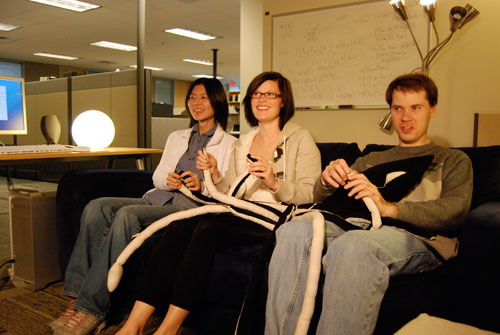
I’m at the Participatory Design Conference in Bloomington, Indiana for a few days, presenting my participatory art project, Body Technology Interfaces. I knitted a bunch of components (sleeves, rectangles, tubes, etc.) and people can come and make their own BTIs to take home. Here’s the description:

“Our interactions with personal electronic devices provoke a broad range of emotions from frustration to confusion to feverish obsession. Increasingly, these devices dominate our everyday work activities, our behavior in public space, and our personal communications. Becky will conduct interviews to help create custom-knitted coverings for participants’ personal electronic devices. The installation aims to bring critical awareness and consideration to the complex relationship between people and technological artifacts. Each BTI will reflect salient interaction behaviors between the participant and their chosen device, as well as provoke thought in observers.

You’re invited to participate in creating your own Body Technology Interface using the knitted components provided in the installation. After working with Becky on a design and sketch, a kit of parts will be assembled for the execution of your design. You may choose to sit and work on your creation at the table workspace, take your kit with you to assemble during other sessions, or leave it with Becky to assemble and pick it up later. Photos and thoughts will be documented on the project website.”

Stay tuned for pictures of new BTIs created at the conference.

CAPTCHA Paintings

lisp

CAPTCHA (Completely Automated Public Turing test to tell Computers and Humans Apart) images are used to thwart internet bots from creating accounts or posting spam. I collect particularly attractive CAPTCHA images, then recreate them in acrylic. If you have a favorite CAPTCHA, you can commission is as a painting through my Etsy Shop.

CAPTCHA Painting

asius

CAPTCHA painting

YFHWR

CAPTCHA painting

qGphJD

CAPTCHA painting: "FW1K9"

FW1K9

CAPTCHA painting: "draddl"

draddl


First Amp

Painted the grill holes

Lift the lid

I made this audio amplifier from the Little Gem Mk II circuit, and housed it in this box I found at a thrift store. It has a little drawer at the bottom that I’ll use for accessories.

VizProto Class

VizProto (3D Visualization and Rapid Prototyping) Class (class website)

Instructors: Dan Collins and Arius Elvikis

Spring 2008, Arizona State University

This is a studio about computer visualization, modeling, and rapid prototyping in an interdisciplinary manner.

Projects will include:

A. Benchmarks
-3D Laser Scanning
2008-01-30: Sarah Hatton and I scanned a pincushion and a ball of yarn.
Laser Scanning
the resulting pincushion model

Laser Scanning
The resulting yarn model

-3D Modeling
2008-01-29: I did my first Rhino tutorial: a flashlight.

My first 3D model

-Rapid Prototyping
3D printed ring

B. Team Projects
-Data Capture
Presentation on Low-tech spacial data capture with Alex Schlegeldownload PDF

-Visualization and Modeling
Presentation on Patterns with Sarah Hatton and Byron Lahey

C. Final Project
-Proposal: RFID Jewelry

Problem Space: RFID tags are currently used by artists in interactive installations and for protypical office and home devices to identify unique individuals. These projects show a great deal of consideration for embeddedness in their environments in true ubiquitous fashion. However, the RFID tags used to identify these individuals are clumsy and unattractive. An example keyfob tag:

Proposal: I would like to embed small flat and glass ampoule RFID tags in attractive resin rings, pendants, and other jewelry that can bring these identification systems closer into alignment with the systems with which they are meant to interact. These systems are highly dependant on the wearability of these tags. Specifically, hand held devices with small, short-range RFID readers would benefit from the tag being located on the hand in a ring as opposed to in a bracelet. As beautiful handmade technological artifacts, I believe these pieces will have commercial value on the online handmade marketplace Etsy. I would model the form of the jewelry in software, rapid prototype for form, make a mold, and cast the items in resin/lucite, embedding the tags while the material is still liquid.
Small glass ampoule tag:

Prior work: RFID bracelets:

RFID bracelet

Design inspiration/precedents by Etsy sellers poolballrings and studiostebbylee:

Work in Progress: Ring Model in Solidworks:

ring-screenshot

3D print:
3D printed ring

Files:
facescan.zip
lowtechdatacapture.pdf

LilyPad Embroidery

LilyPad Embroidery: A Tribute to Leah Buechley

Floss, electronics, conductive thread, custom software

I’ve been working with Leah Buechley’s LilyPad Arduino, and in true embroidery sampler fashion, have composed this circuit to see what I could do. The embroidery uses traditional floss and techniques mixed with lights and sounds generated by the onboard software. The amount of light sensed by the sensor changes the speed and pitch of the lights and sounds generated. Move your shadow or hand over it to experience the changes.

(more…)

Body-Technology Interfaces


Laptop Compubody Sock for privacy, warmth, and concentration in public spaces
2008
Knitted wool, laptop computer

The Laptop Compubody Sock is a one-of-a-kind hand-knit sculpture. It is not a commercial product for sale.

Learn to make your own on Instructables.

See more pictures on Flickr.

Cell Phone Ski Mask Interface

Cell Phone Ski Mask

Ski Mask for Eating a Sandwich

Ski Mask for Eating a Sandwich

Body-Technology Interfaces

Keyboard Interface for Computer Programming

Press: Featured on Engadget, Gizmodo, Lifehacker, and Regretsy.

Files:
BTI_info.pdf

(more…)

New Publications at CHI

I recently had two short papers published at the SIGCHI conference on human factors in computing systems (CHI) in Florence, Italy. My colleague Lisa Tolentino went to present our poster on the Sensor Squid Relation Game. One paper focused more on the squid, entitled Sharing the Squid: Tangible Workplace Collaboration (download PDF) and the other focused more on the game and overarching situation, entitled Creativity Interventions: Physical-Digital Activities for Promoting Group Creativity (download PDF). Above is a picture of Lisa talking about the project at the conference. Photos by fellow attendee Ryan Spicer.

Sensor Squid

Sensor Squid Relation Game, by Rebecca Stern and Lisa Tolentino in the Arts, Media and Engineering Program at ASU, 2008

The Reflective Living Group in AME is currently developing a tangible mediated environment designed to facilitate the growth of group creativity between colleagues in a transdisciplinary research workplace. Our initial work in developing playful mediated work environments contributes to a framework for constructing “creativity interventions,” some of the goals of which are to (1) stimulate constructive discourse, (2) strengthen social bonds, and (3) enhance creative output in diverse communities of IT practitioners. Through our multi-user tangible interface in the form of a plush sensor-enabled squid, participants can share media resources and collaborate in a playful and inviting setting.

(more…)

TV-B-Gone Tampon Case

I just got a new Adafruit Industries TV-B-Gone v1.1 kit, and decided to embed it into my tampon case. I never needed to carry around that many tampons, anyway! It still holds two, plus the electronics. I pulled out the switch on the PCB to the outside of the case so it can easily be activated while holding it, but also by items on a table! I find one of the most useful places for the TV-B-Gone is in restaurants. The button points slightly downward, so you can slyly press it by moving it up against something on the table, like your wine glass, flatware, etc. TVs don’t always bother me, but now I can turn them off during my most irritable time of the month.

finished

These photos are also available in a Flickr set of the construction.

sGloTaT

sGlobject Trumpet & Tambourine (sGloTaT) by Ryan Brotman, Byron Lahey, and Rebecca Stern

The sGloTaT sonic environment allows participants to originate sound by moving physical objects. It encourages novice users to play by naturally gesturing with two tangible user interface objects emulating a trumpet and tambourine. In this sound space, movements by the users generate visual feedback projected on the floor in the form of a three-dimensional rendering of a cone.

More photos are available at the Flickr set.

http://blip.tv/scripts/flash/showplayer.swf?enablejs=true&file=http%3A//blip.tv/rss/flash/535030&feedurl=http%3A//sternlab.blip.tv/rss/&autostart=false&brandname=Sternlab&brandlink=http%3A//sternlab.blip.tv/

This is the final project for Computational Principles for Media Arts, a fall 2007 class in Arts, Media and Engineering at Arizona State University. Please download the following paper for more information.

Files:
sGloTaT_BrotmanLaheyStern.pdf