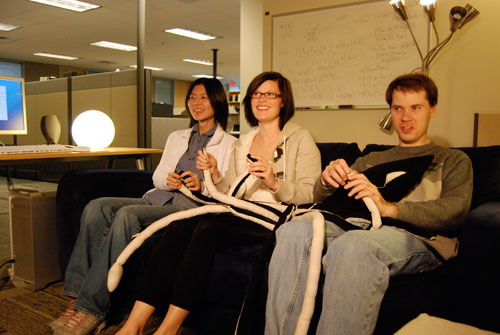
Sensor Squid Relation Game, by Rebecca Stern and Lisa Tolentino in the Arts, Media and Engineering Program at ASU, 2008
The Reflective Living Group in AME is currently developing a tangible mediated environment designed to facilitate the growth of group creativity between colleagues in a transdisciplinary research workplace. Our initial work in developing playful mediated work environments contributes to a framework for constructing “creativity interventions,” some of the goals of which are to (1) stimulate constructive discourse, (2) strengthen social bonds, and (3) enhance creative output in diverse communities of IT practitioners. Through our multi-user tangible interface in the form of a plush sensor-enabled squid, participants can share media resources and collaborate in a playful and inviting setting.
Scarf Rly, an “O Rly” Owl scarf pattern. Created by Rebecca Stern, original idea by Justin Gutterman. One end says “O Rly?” and other other, “Ya Rly.” Because I hate the way carried-yarn patterns have a front and back, I tried to weave the carried yarn through the knit-1-purl-1 pattern of the scarf, but I’m not quite happy with it. Sure, the image has no front and back now (except the readability of the text), but it’s a bit dense, not stretchy, and slow-going.
sGlobject Trumpet & Tambourine (sGloTaT) by Ryan Brotman, Byron Lahey, and Rebecca Stern
The sGloTaT sonic environment allows participants to originate sound by moving physical objects. It encourages novice users to play by naturally gesturing with two tangible user interface objects emulating a trumpet and tambourine. In this sound space, movements by the users generate visual feedback projected on the floor in the form of a three-dimensional rendering of a cone.
This is the final project for Computational Principles for Media Arts, a fall 2007 class in Arts, Media and Engineering at Arizona State University. Please download the following paper for more information.
I made this plush cuttlefish for my niece, who’s 1.5 years old. Her mom’s a marine ecologist, so why not encourage her propensity towards a nautical theme? My sister, brother in-law, and niece travel a lot, so I included a security handle, good for strapping the toy to a backpack or stroller.
Sternlab’s Becky Stern has collaborated with artist Rees Shad on the Declarative Lamp Project, on display as part of the Kingston, NY Sculpture Biennial through October, 2007. (Lamps are on display in the uptown Kingston Peace Park)
Mr. Shad writes:
In January of 2007 the city of Boston was partially paralyzed by a bomb scare wherein a number of found electronic devices were seen as potential explosives. The devices featured a number of small flashing lights depicting a cartoon alien performing a crude gesture. Intended to advertise the upcoming season of a popular animated television show, this misadventure in guerilla marketing was perceived as a potential hazard to the population, or, even worse, a terrorist act. The Bomb Squad was called out to destroy the devices, and the city’s major traffic paths came to a standstill for most of an afternoon. My first thought upon hearing about the Boston scare was that our fears had gotten the best of us. My next thought was that I needed to address this in my work as an electronic installation artist.
The Declarative Lamp Project, created in collaboration with artist Rebecca Stern, uses electronic performance to explore the extent to which fear has been instilled in American culture. Witnesses in a park experience seemingly innocuous electronic pathway lighting that comes alive at dusk with lights and voices in many languages declaring, “I am not a bomb.”
Because these devices exist in a natural environment and use human voices, I wished to add natural and personal elements to the Lamps’ execution. As a child, I remember being fascinated by the mathematical equation to calculate air temperature from the frequency of cricket chirps. If one monitors a single chirping cricket for 15 seconds, the number of chirps plus 39 is the air temperature (in Fahrenheit). In our piece, this equation has been reversed to allow the evening’s temperature to establish the rhythm of the declarative voices. In cold temperatures, the lamps speak less often than in warm.
To give an innocuous overtone, we chose a number of Arts & Crafts style solar-powered garden lights as the framework within which to build our project. Ordinarily, these lamps store energy during daylight hours and engage an energy-efficient LED light at dusk. Ms. Stern and I have repurposed these lamps to flicker as if they hold lightning bugs in correlation with the recorded messages. This process begins at dusk, producing a chorus of voices whose rhythm is directly related to the temperature of the evening air. The lamps each repeat the phrase “I am not a bomb” in one of twelve languages. After a twenty-minute performance, the lamps power down to await the next sunset.
I made a reusable lunch bag out of a FedEx Tyvek mailing envelope. I modeled it after a paper lunch sack. To keep glue away from our food, I used a sewing machine to do up the seams. Because Tyvek is tear-resistant, the stitches should hold it for many lunches. It should make a great water resistant, reusable alternative to the paper sack. I don’t expect it to last forever, just until I find another free Tyvek envelope.
The word “holon” signifies a collection of nested systems. Based on the writings of Michael Pollan and Arthur Koestler, Holon A. reflects the holons of American industrial agriculture through an interactive miniaturization. Five integrated modules invite the visitor to ask questions about the efficiency of our industrialized ecosystems. Diorama-style modules cover such topics as E. coli contamination during fabrication of beef, the varying public uses of the term “chicken,” traditional fiber arts, and the government’s role in the American corn economy. Holon A. utilizes a wide variety of industrial and hand-made materials from electronic components and wood to hand-silkscreened plush steak.
Holon A. at the Chelsea Art Museum, 2007
The modules
The radiation level required to combat E. coli contamination of livestock varies with the amount of corn in the cattle’s diet, as it is not its natural food source.
Corn Currency asks about the US government’s role in the market value of corn, and when the corn economy is good, livestock eat more of it. The visitor is left with plastic waste.
The cornstalks’ adjustable light source self regulates the light output and also influences glowing of the beef module.
The fiber module consists of a knitted viewer with sound to encircle the face, giving the feeling of a private space. The conforming body of the knitted object reflects our once traditional fiber practices being industrialized under our noses.
Live Internet-scraped images can be seen as the somewhat “public” opinion of chicken today. The visitor has control over the playback of these images.
The modular, rough-cut construction fits with the conceptual framework of industrialization of nature.